How to Use AI for Product Listings That Convert
AI has become a useful tool for ecommerce teams, not because it replaces writers or strategists, but because it helps speed up execution and improve clarity. When used intentionally, AI can support keyword research, bring structure to product descriptions, and generate working drafts of titles and metadata. When used carelessly, it produces vague, generic copy that lowers trust and hurts conversions.
This guide explains how to use AI to improve your workflow, so your product listings remain accurate, search-friendly, and persuasive.
Why AI Helps With Product Listings (But Can’t Replace Strategy)
AI is good at pattern recognition and organization. It can quickly turn messy inputs into something usable, which makes it especially helpful during product onboarding or catalog refreshes.
It can assist with:
Brainstorming keyword ideas
Condensing long supplier descriptions
Organizing product attributes
Rewriting unclear or repetitive sentences
Producing draft SEO titles and meta descriptions
Where AI falls short is context. It doesn’t know your customer, your competition, or what actually drives conversions in your category. Left on its own, it defaults to vague language and filler phrases—exactly the kind of copy that makes listings feel generic and untrustworthy.
At Your eCommerce Team, AI is part of our workflow, but never the decision-maker. Strategy, keyword targeting, and final copy always come from humans who understand ecommerce, search behavior, and merchandising.
Step 1: Use AI for Keyword Research and Search Intent Insights
AI is particularly useful at the start of keyword research. It can quickly surface long-tail phrases, attribute-based searches, and use-case language that shoppers actually use.
You might prompt AI with something like:
“List search terms shoppers use when looking for western men’s striped shirts. Include material, fit, and style.”
From there, you’ll often get a solid starting list, but not a finished one.
Real-world example:
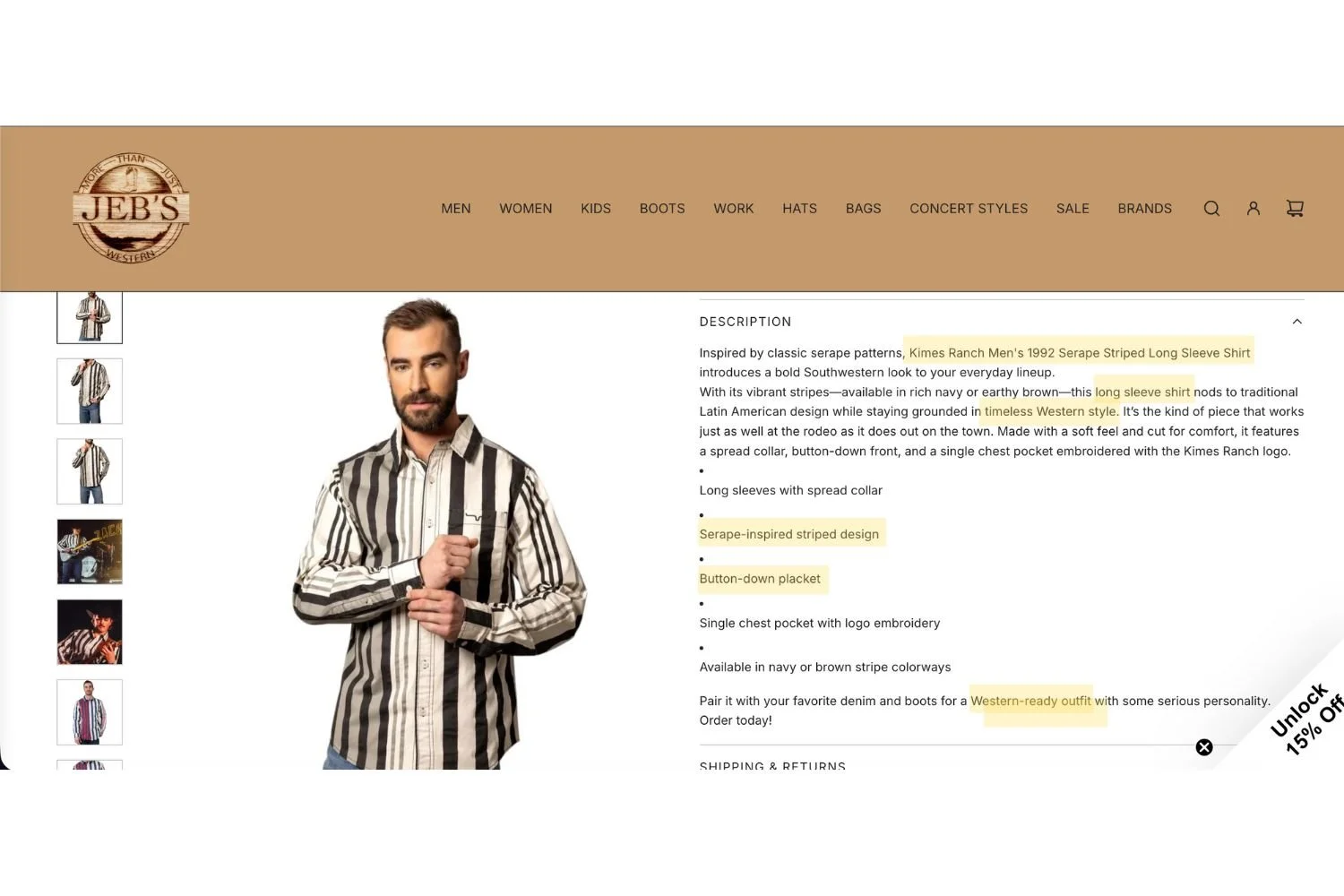
Jeb’s Western Wearhouse – Men’s Shirt Product Page
In the attached screenshot from the Jeb’s Western Wearhouse website, you’ll notice keywords like “long sleeve shirt,” “serape-inspired striped design,” and “timeless Western style” appear naturally in the product description. These weren’t guessed; they were verified against site search data and category intent before being finalized.
That’s the key distinction:
AI can suggest keywords
Humans confirm search demand and relevance
Before finalizing keywords, it’s important to validate them using real data, such as Google autocomplete, Shopify search analytics, marketplace tools like Amazon or Etsy, and competitor product categories.
AI speeds up ideation. Strategy ensures accuracy.
Step 2: Use AI to Improve Product Descriptions With Clear Structure
AI is excellent at organizing content, especially when descriptions start as rough notes or supplier copy. The highest-converting listings usually follow a simple flow:
Features → Benefits → Use Cases
Instead of long paragraphs, clarity wins.
Before (unstructured):
“Women’s boots made from durable leather. Good for outside.”
After (AI-assisted, human-refined):
Full-grain leather for long-lasting wear
Insulated lining for winter ranch work
Reinforced outsole for traction
Available in standard and wide widths
Real-world example:
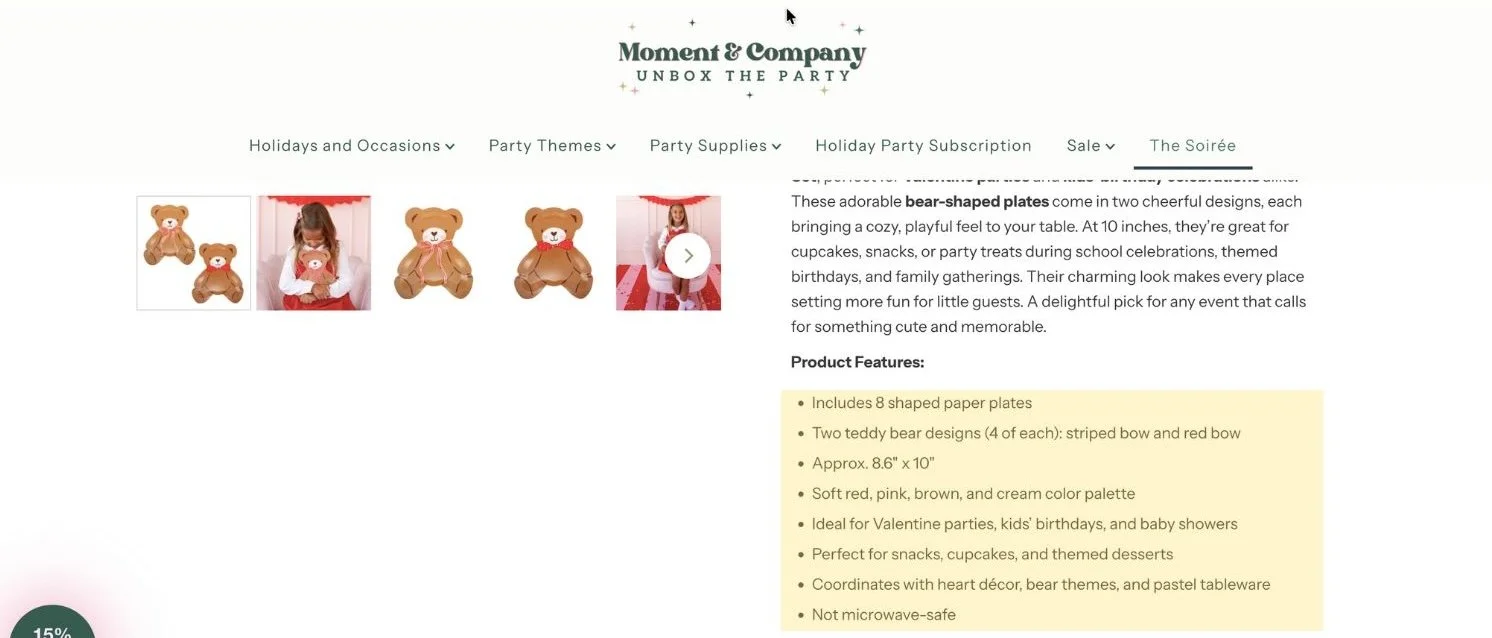
Moment & Co product page
In the Moment & Co example provided, the product features are clearly separated, scannable, and specific. AI can help generate this structure, but the accuracy of dimensions, materials, and use cases was verified by a human before publishing.
AI is helpful for cleanup and formatting, but it can’t fact-check. That part is non-negotiable.
Step 3: Use AI to Draft SEO Titles and Meta Descriptions (Then Refine Them)
One of AI’s biggest strengths is speed. It can generate multiple title and meta description options in seconds—giving you choices instead of starting from scratch.
For example, prompting:
“Write 5 SEO titles for gold scalloped party plates under 60 characters.”
AI might return several workable drafts. From there, you refine based on:
Keyword priority
Brand tone
Character limits
Click intent
Real-world example:

Moment & Co – Google search preview
The attached SERP example shows a concise, keyword-focused title paired with a clear meta description. This wasn’t published directly from AI; it was edited to remove fluff, tighten language, and align with search intent.
AI helps you generate options. Humans choose the one that actually performs.
Step 4: Avoid Generic AI Copy Pitfalls
This is where many DIY AI product listing attempts go wrong. Without guardrails, AI tends to overproduce copy that sounds polished—but says very little.
Common issues we see:
Overused phrases like “premium quality” or “ultimate upgrade”
Vague benefits without proof
Incorrect features AI invents
No brand voice or differentiation
Long descriptions with no hierarchy
These issues don’t just hurt SEO—they hurt trust.
At Your eCommerce Team, our role is to pressure-test AI output. We remove filler, correct inaccuracies, and make sure every line supports conversion or clarity.
AI drafts faster. We make it usable.
Step 5: Use AI to Speed Up Your Workflow While Keeping Strategy Human-Led
AI is an excellent assistant for repetitive or time-consuming tasks:
Drafting bullets
Rewriting supplier descriptions
Condensing long copy
Generating metadata variations
Structuring product attributes
This is especially valuable when onboarding dozens—or hundreds—of SKUs.
What AI cannot do is lead your ecommerce strategy. It doesn’t understand:
Keyword prioritization
Merchandising strategy
Marketplace requirements
Shopify collection structure
Brand voice consistency
Platform-specific optimization (Amazon vs Shopify vs Faire)
Those decisions require experience and human insight.
How Your eCommerce Team Uses AI the Right Way
For our product listing, SEO, and marketplace clients, AI is never the writer—it’s the assistant.
We pair AI efficiency with human expertise to ensure listings are:
Accurate and complete
SEO-driven
Brand-aligned
Conversion-focused
Marketplace compliant
Consistent across channels
AI creates momentum. Our team ensures the work actually drives revenue.
Conclusion: Strategy Turns AI Output Into Sales
AI is a powerful tool for ecommerce businesses, but it cannot replace the strategic thinking behind a high-converting product listing. Use AI for speed and clarity, but rely on specialists to ensure your product pages are accurate, persuasive, and aligned with how customers actually shop.
If you’re ready to improve your product listings, refine your SEO, or scale product onboarding without sacrificing quality, Your eCommerce Team can help.
Ready to improve your listings? Contact Your eCommerce Team today:
https://www.yourecommerceteam.com/contact
